 English
 Arabic
 Chinese (Simplified)
 Dutch
Dutch French
 German
 Indonesian
 Italian
 Japanese
 Khmer
Khmer Korean
 Lao
Lao Portuguese
 Russian
 Spanish
 Thai
Thai Vietnamese
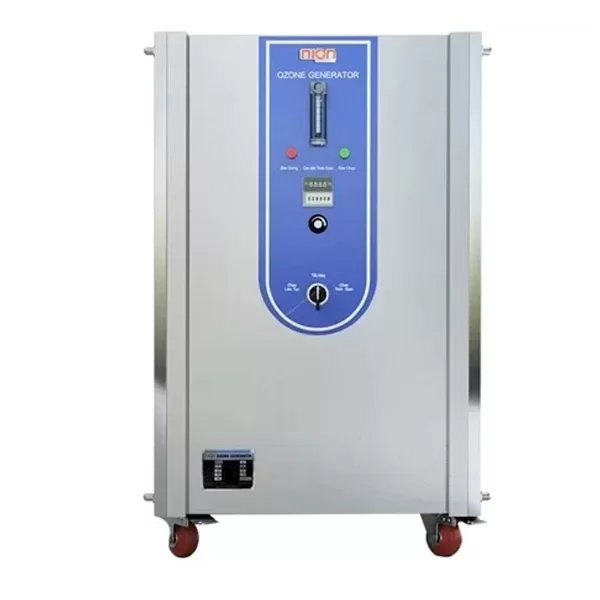
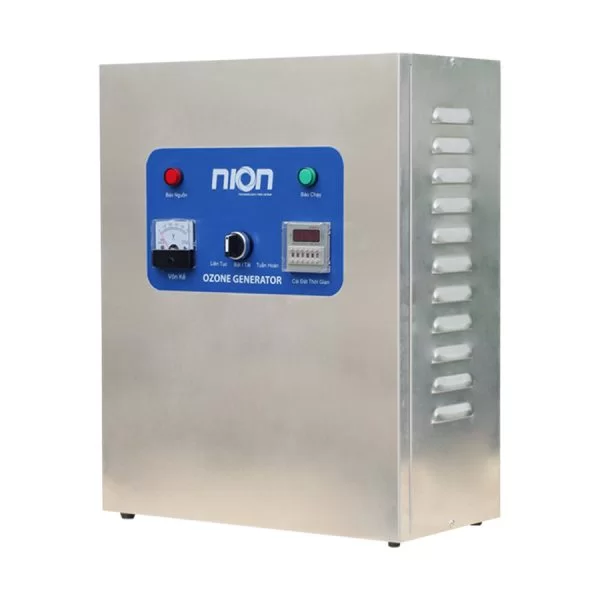
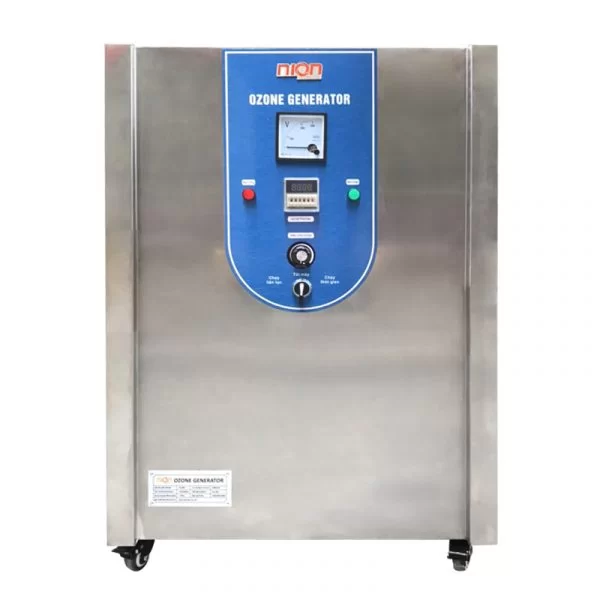
Nion N100 Industrial Ozone Generator
Ozone Output: 100 g/hr
Ozone Concentration: 85 g/m³
Oxygen Flow Rate: 20 L/min
Power Supply: 220V – 50Hz – 1800W
Dimensions: 150 × 140 × 55 cm
Weight: 140 kg
Ozone Chamber Cooling: Water-cooled, 8 L/min
Machine Housing Material: Stainless Steel
Frame Material: Stainless-steel frame, 30 × 30 mm box-type structure
Mixing System: Specialized mixer pump + injector
Ozone-to-Water Ratio: 8 – 10%
Pressure Balancing Valve: LS 01I type
Warranty:
-
3 years for the ozone generator module
-
12 months for the machine body
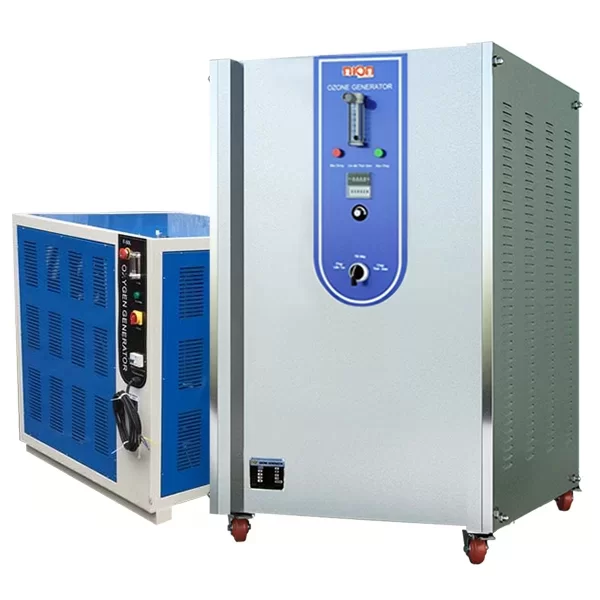
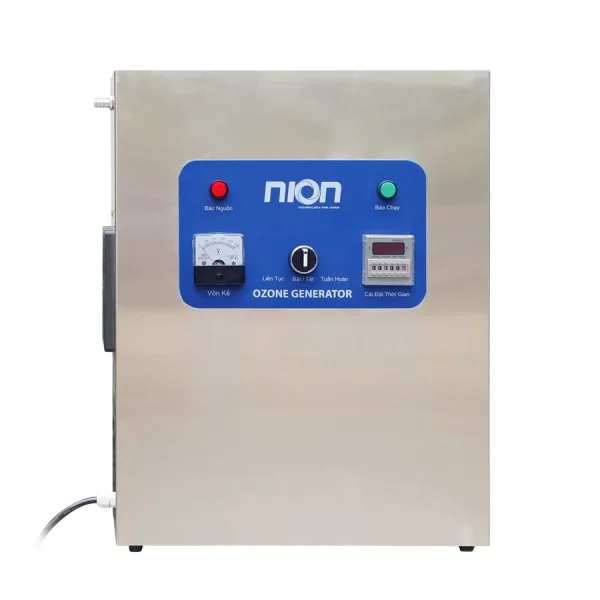
The Nion N100 industrial ozone generator is used in a wide range of water treatment systems including industrial wastewater treatment, clean water production, aquaculture water treatment, swimming pool disinfection, and VietGAP-standard hydroponic farming systems.
With an output capacity of 100 g/h and an ozone concentration of 85 g/m³ (adjustable upon request), the N100 features a high-performance ozone discharge chamber, fundamentally superior to the ozone modules used in low-cost industrial ozone machines on the market.
Built according to Japanese technology and product quality standards, Nion ensures that every machine is finely engineered, structurally stable, and capable of long-term reliable performance.
Why Choose Nion Industrial Ozone Generators?
-
Industrial-grade stainless-steel design:
Made from 100% SUS 304 with a reinforced structure, offering superior durability and mechanical rigidity compared to typical ozone generators. -
High-performance industrial ozone discharge tube:
Optimized thermal dissipation keeps chamber temperature within 20–40°C, increasing O2–O3 conversion efficiency and reducing reverse conversion. Wider ventilation windows and improved fan placement provide better airflow and cooling. -
Adjustable ozone output & concentration:
Users can fine-tune ozone levels as needed. The system features automatic error detection and multiple flexible operation modes. -
Extended warranty up to 36 months (or customized warranty upon request).
-
Electrical safety:
The Nion ozone module is precision-welded using industrial standards, with high-voltage cables, large-current conductors, and an integrated short-circuit protection system. -
Easy mobility:
Equipped with heavy-duty wheels and safety locks. -
Sealed components for long lifespan:
100% of internal components are solid-block casted, providing superior moisture resistance, stability, and anti-interference capability. -
High-purity ozone output:
Integrated oxygen-concentration system following strict medical-grade standards. Oxygen purity exceeds 90% before entering the ozone chamber, minimizing contamination and enhancing ozone purity.
Features & Design of the Nion N100 Industrial Ozone Generator
(If you want, I can expand this section into full SEO-optimized content.)
Applications of the Nion N100 in Drinking Water Treatment
Due to its exceptional disinfection and oxidation capabilities, ozone is widely used in drinking water treatment.
Ozone can be injected at different stages in the system: pre-oxidation, intermediate oxidation, or final disinfection.
It is commonly used before sand filtration or granular activated carbon (GAC) filtration to enhance efficiency. After ozonation, these filters easily remove remaining organic pollutants.
Key benefits include:
-
Removal of organic and inorganic contaminants
-
Removal of micro-pollutants such as pesticides
-
Enhanced coagulation/flocculation efficiency
-
Improved disinfection while reducing harmful disinfection by-products
-
Elimination of unpleasant taste and odor
1. Removal of Organic and Inorganic Matter
Natural water sources always contain NOM (Natural Organic Matter), which contributes to odor, color, taste, and the formation of harmful disinfection by-products (DBPs).
Ozone partially oxidizes NOM, making it more biodegradable (increases BDOC), which enables biological filters to remove it more effectively.
Ozone combined with coagulation and bio-filtration can reduce DOC by up to 64%, compared to only 13% with bio-filtration alone.
2. Removal of Pesticides
Pesticides may be present in both surface water and groundwater.
Studies show ozone is highly effective at degrading many types of pesticides. In the Netherlands (Zevenbergen), a combination of GAC + ozone + GAC achieved excellent pesticide removal results.
For more persistent pesticides, higher ozone dosage or Ozone + H₂O₂ AOP treatment is recommended.
3. Reduction of Disinfection By-Products & Improved Disinfection
Chlorine reacts with organic matter to form dangerous DBPs such as THMs.
Ozone also forms by-products, but they are mostly aldehydes and ketones, which are easily biodegradable via biological filtration and do not violate drinking-water regulations.
Using ozone for pre-oxidation can reduce DBP formation potential by 70–80% when chlorine is used as the final disinfectant.
Ozone is also far more effective than chlorine, chloramine, or chlorine dioxide for primary disinfection—especially against chlorine-resistant organisms.
4. Taste and Odor Removal
Taste and odor issues arise from:
-
Decomposed organics
-
Biological activity
-
Inorganics (iron, copper, zinc)
-
Chlorine oxidation reactions
Ozone effectively oxidizes many of these compounds (20–90% efficiency depending on compound type).
It rapidly eliminates odor-causing compounds such as geosmin and 2-methylisoborneol (MIB).
Reviews
There are no reviews yet.