 English
 Arabic
 Chinese (Simplified)
 Dutch
Dutch French
 German
 Indonesian
 Italian
 Japanese
 Khmer
Khmer Korean
 Lao
Lao Portuguese
 Russian
 Spanish
 Thai
Thai Vietnamese
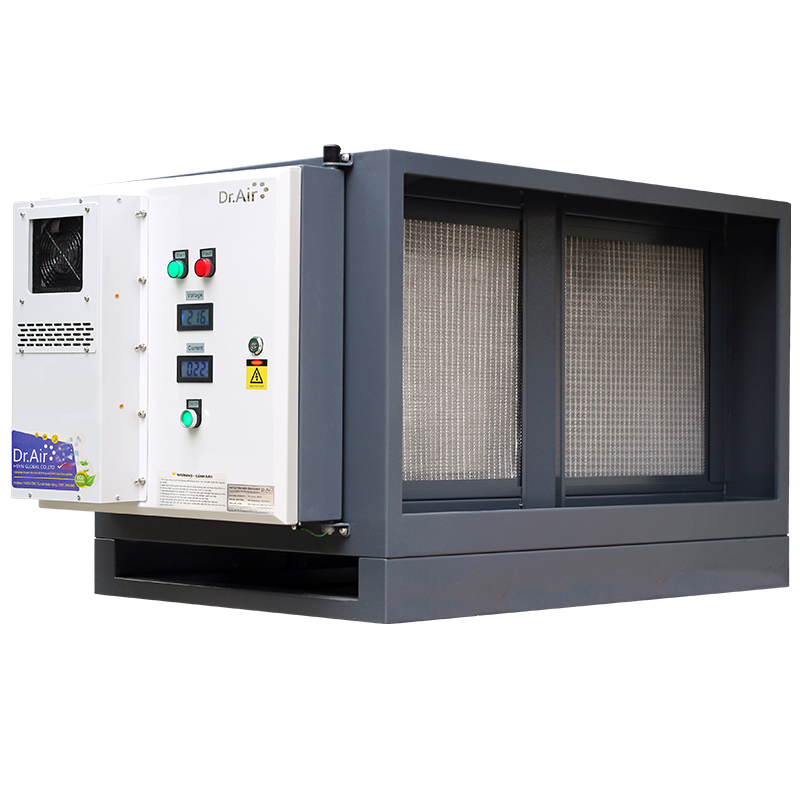
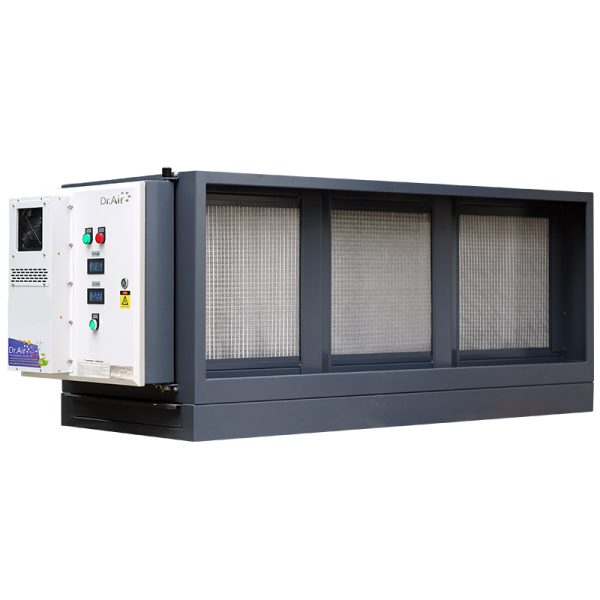
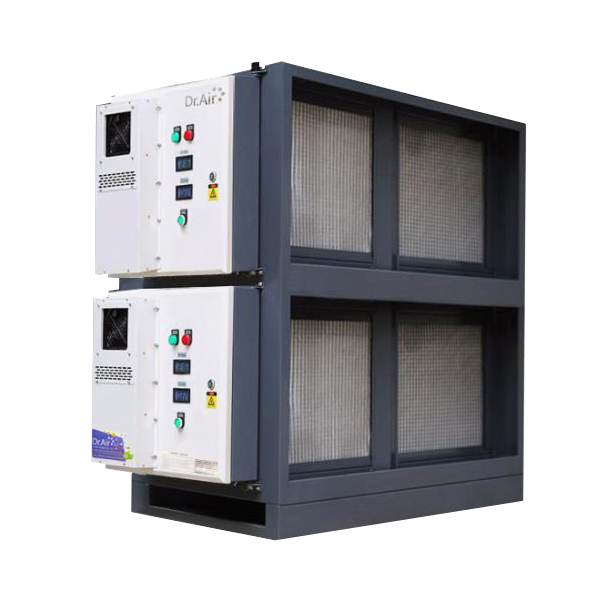
Dr.Air KT8000 Electrostatic Filter for Kitchen Smoke Treatment
- Model: Dr.Air KT8000
- Traffic: 8000
- Number of circuits: 1
- Circuit capacity: 300W
- Voltage: 220V
- Number of filters: 2
- External dimensions (LxWxH): 800x 950x 710 mm
- Shooting size (WxH): 640*500 mm
Dr.Air KT8000 ESP electrostatic dust filter model has a standard processing capacity of 8000m3/h, integrated with 2 controllers, using 220 – 240V power source to create a high voltage environment of 18000V. Electrostatic dust filter is used in kitchen exhaust treatment systems or industrial exhaust treatment applications, effective in removing grease fumes, smoke and dust pollution. ESP electrostatic dust filter system can be ducted or freely hung for air circulation.
Outstanding structural features


Advantages of Dr.Air KT8000 electrostatic dust collector
- Electrostatic filtration is the leading technology in smoke removal, grease filtration, dust filtration, achieving high efficiency up to 95% – 99%. The cleaning principle is to charge the dust particles in the exhaust air stream, turning them into negative ions. According to the properties of this material, these particles are quickly attracted by the opposite electrode (filter wall), stick tightly to the wall surface and cannot go out.
- Modular design, easy to integrate to create large capacity, handle low to high emissions
- Easy routine maintenance
- Does not produce secondary pollutants
- The filter can be reused many times by regular cleaning under high pressure water.
- Maximum response to exhaust gas cleaning needs in factories, processing zones, industrial kitchens, etc.

Model – OPTION 2: We use an industrial kitchen exhaust gas treatment system that includes the following components and equipment.
Application of electrostatic precipitator in treatment of cement kiln exhaust gas
Cement emissions have attracted great attention in recent years because this industry contributes significantly to environmental pollution. However, cement production plays an important role in the country’s economic development as well as solving the problem of employment for workers. Therefore, although the cement industry has a negative impact on the environment, it is still growing. The problem is finding solutions to treat emissions, minimizing the spread of cement dust into the atmosphere.
Among the pollutants caused by the cement production process, heavy metals account for the largest component, typically mercury (Hg), cadmium (Cd), thallium (Tl), cobalt (Co), antimony (Sb), arsenic (As), lead (Pb), tin (Sn), selenium (Se), tellurium (Te), chromium (Cr), copper (Cu), manganese (Mn), nickel (Ni), vanadium (V) and zinc (Zn). Different heavy metal (HM) dust particles have different dispersions into the atmosphere covering up to thousands of kilometers around the emission source and gradually depositing.
HMs are produced from the combustion of raw materials, fuels and wastes, during smelting processes. Their concentrations and dispersion depend largely on their volatility and temperature. HMs exist in various chemical forms such as complex particles, oxides, salts or in gaseous form. In addition, their toxicity depends on their chemical characteristics .
Electrostatic precipitators (ESP) in general and Dr.Air KT8000 electrostatic precipitators in particular are used to clean the air in most parts of cement production. They not only help solve the problem of metal dust but also actively support environmental protection by not producing secondary pollutants, saving electricity. Depending on the characteristics of the exhaust gas source, an electrostatic precipitator with appropriate capacity is selected, meeting the maximum requirements of the State in environmental protection.
Reviews
There are no reviews yet.